
Ramps and driving lanes vanish, so the same building volume stores two to three times the cars.
Reference guide
Multi Level Car Parking
How to park two to three times more cars on the same land — the systems, the density maths, the throughput sizing, the cost drivers and the design decisions that have to be made before the structure is poured.
Cities run out of ground long before they run out of cars. Multi level parking answers that by going vertical — this guide covers every route to it, from a simple two-car stack to a fully automated tower, with the trade-offs laid out plainly.
- 2–3×More cars in the same building volume versus conventional parking
- 30–40%Of a conventional structure lost to ramps and circulation
- 9Distinct mechanical system types, each for a different site
- 1–3 minTypical park-and-retrieve time in a mechanical system
Section 01
What multi level car parking is
Multi Level Car Parking (MLCP) is parking infrastructure that stores cars on two or more vertical levels within a single footprint, using either conventional ramp-based structures or mechanical systems that lift and move cars without a driver on board.
The full form of MLCP is Multi Level Car Parking. It is also called a multi storey car park, a parking garage, or a multi level parking structure. The category is also known as automated parking when the system operates without human intervention inside the storage area. The defining idea is the same in every case: buy capacity with height instead of land.
Urban populations are growing, car ownership is growing faster, and the supply of developable land is fixed. Every developer, architect and city planner working in a dense market eventually runs into the same arithmetic — the parking requirement will not fit on the ground area available, and the ground area is the most expensive thing in the project.
MLCP resolves that by creating parking levels above or below grade within a given footprint. The category spans a wide range: at one end, a conventional ramped structure that a driver navigates personally; at the other, a fully automated system where the driver never enters the storage area at all and cars are moved by servo-driven carts under laser guidance.
The distinction between those two ends is not cosmetic. It changes how much of the building actually holds cars, how fast the facility clears at peak, what it costs to run for twenty years, and how much land is left over for everything else the project needs to do.
- A conventional ramped structure that a driver navigates personally
- Semi-automated stack and puzzle systems See Section 12, degree of automation
- A fully automated system where the driver never enters the storage area at all and cars are moved by servo-driven carts under laser guidance
It changes
- how much of the building actually holds cars
- how fast the facility clears at peak
- what it costs to run for twenty years
- how much land is left over
Context
By 2030, close to 60% of the world's population is projected to live in urban areas (UN World Urbanization Prospects). In major commercial districts across Asia, the Middle East and Africa, parking demand already outpaces available land by a factor of three to five.
Section 02
Where multi level car parking is used
MLCP has moved from a specialist solution to a standard component of urban development. It appears wherever parking demand is concentrated and land is not available to spread out.
- 01Residential apartment complexes
- 02Commercial office buildings
- 03Hospitals and healthcare campuses
- 04Airports
- 05Railway and metro stations
- 06Shopping malls and retail centres
- 07IT parks and tech campuses
- 08Hotels and hospitality
- 09Educational institutions
- 10Mixed-use developments
- 11Government and municipal buildings
- 12Industrial and manufacturing facilities
The brief is consistent across all of them: meet the parking requirement while consuming as little land and built-up area as the project can afford to give up.
Delivered scale
Sieger Parking has installed 15,000+ car spaces across India, including multi-speciality hospitals in Coimbatore, Vellore and Chennai; one of India's largest retail destinations in Chennai; large residential developments in Mumbai and Chennai; and a fully automated public facility in Coimbatore under the Government of India's Smart Cities Mission.
Section 03
What MLCP is worth to a project
Compared with surface parking, a multi level system changes five things that show up directly in the project's numbers.
Higher parking density
A well-designed MLCP delivers two to five times the capacity of a surface lot on the same footprint, depending on system type and level count. This is the headline benefit and the reason the category exists.
Land released back to the project
Building vertically frees ground area for landscaping, amenities, leasable space or additional construction. In urban markets where land trades at ₹10,000 to ₹50,000+ per sq. ft., the released area is often worth more than the parking system costs.
Controlled, enclosed security
Access control, surveillance and an enclosed envelope cut exposure to theft, vandalism and weather damage. In mechanical systems the parked cars sit behind a boundary no member of the public crosses at all.
Better FSI utilisation
Meeting the parking requirement in less area frees floor-space index for revenue-generating use. Parking efficiency is one of the few levers that improves project returns without changing the development's programme.
Compliance without over-building
Indian municipalities and urban local bodies mandate parking ratios by built-up area and building type. MLCP lets a project meet those ratios without surrendering an unreasonable share of land or floor area to parking alone.
The land arithmetic
A single surface parking space, including its share of the driving lane, occupies roughly 25 to 30 sq. m. of land. A 1,000-car surface lot therefore consumes close to 3 hectares. A multi level structure delivers the same capacity on a fraction of that ground area — the difference is the land the project gets to keep.
1 surface space
roughly 25 to 30 sq. m.
including its share of the driving lane (hatched)
1,000-car surface lot
close to 3 hectares
50 × 20 spaces, drawn in rows with aisles. Not to scale with the single space.
Fig. 3.2
Value addition for real estate
Land recovered becomes value created
Two ways to read the same move — a smaller parking footprint becoming a stronger project return.
−66%ground for the same car count — the rest is freed for other use
- Leasable / saleable area↑↑
- Property valuation↑
- Rental yield↑
- Amenity & green space↑
Illustrative, not a valuation. The exact uplift depends on local land value, the development programme and how the released area is used — but the direction is consistent: less land to parking means more land to value.
Section 04
How multi level parking evolved
Parking was first solved with open surface lots — cheap to build, simple to operate, and increasingly indefensible as urban land values rose. As buildings went vertical, parking followed: basements, podiums and dedicated parking garages appeared to hold more cars within tighter plots.
Origin
The world's first multi storey car park was built in London in 1901 — a seven-floor structure originally serving horse-drawn carriages, later converted for motor cars. More than a century on, stacking cars vertically is still the core move in parking design; only the machinery has changed.
But conventional multi storey structures carry a structural inefficiency that cannot be designed away: a substantial share of the building is given over to ramps, circulation lanes, turning radii, ventilation plant and driver movement. In most conventional facilities those supporting elements consume 30% to 40% of total floor area. Only the remainder actually holds cars.
That inefficiency is what produced mechanical parking systems. If the car is moved by machinery rather than driven, the ramps and lanes are not needed, the level height can drop from occupied-space height to roughly car height, and the volume freed up becomes storage. From that point, multi level parking splits into two families.
- Open surface lots Cheap to build, simple to operate.
- Basements, podiums and parking garages As buildings went vertical, parking followed. 1901 London: the first multi storey car park, seven floors.
- Mechanical parking systems The car is moved by machinery; ramps and lanes are not needed.
Conventional parkingSection 05
- Basement
- Podium
- Standalone structures
- Surface lots
Mechanical parkingSection 06
- Puzzle
- Tower
- L-cart tower
- H-cart tower
- Fully automated
- Rotary
- Stack
- Pit-stack
- Pit-puzzle
Section 05
Conventional parking
In conventional parking the driver personally drives through the facility to reach a space, using ramps, circulation roads, turning areas and parking aisles. It remains the most widely built form of parking worldwide, largely because it is familiar and requires no operating discipline from users.
Basement parking
Built below grade, common in residential towers, commercial developments, hotels and mixed-use projects. It preserves above-ground area for revenue and amenity, but demands excavation, waterproofing, ventilation and drainage — making it one of the most capital-intensive elements of an urban development.
Podium parking
Occupies the lower floors above grade, typical in commercial buildings, IT parks, malls and residential towers. Access and natural ventilation are easier than deep basements, but it consumes built-up area that could otherwise be let or sold.
Standalone parking structures
Buildings dedicated entirely to parking — the classic multi storey car park — used at airports, railway stations, commercial districts and large retail destinations. High absolute capacity, but a substantial land and construction commitment.
Surface parking lots
The cheapest option to build and the least efficient use of land. Increasingly uneconomic wherever land carries urban value.
Cost signal
In high-density urban markets, a single basement level can cost ₹4,000 to ₹7,000 per sq. ft. or more depending on soil conditions and waterproofing scope — before any parking equipment is considered.
Section 06
Mechanical Parking
In a mechanical parking system, often described as automated parking, the driver stops at a ground-level transfer bay, gets out, and the machinery takes over — lifting, sliding or rotating the car to a slot. Retrieval reverses the sequence. Because no one drives inside, there are no ramps, no lanes, no turning circles and no need to size levels for standing headroom.
The result is substantially higher density per square foot of built-up area — and higher density is what turns into the returns below.
Fig. 6.1
Why the density matters
One site, working three ways harder
Land and floor-space freed from parking return to revenue use, lifting valuation and rental yield.
A compact footprint frees frontage and ground area for retail and amenity, drawing more visitors in.
The nine mechanical system types each suit a different site. Filter by your condition, or read them in full.
Filter by site condition
Showing all nine mechanical system types.
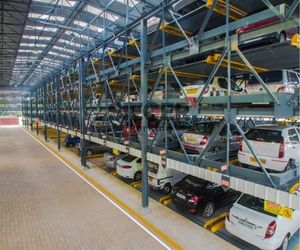 PUZZLE
Platforms shift vertically and horizontally like a sliding puzzle, rearranging themselves to bring the requested car to grade. The workhorse of open-site and podium applications.
- Motion
- Vertical + horizontal platform shift
- Levels
- Up to 7, expandable horizontally
- Suits
- Ground level, podium, open sites
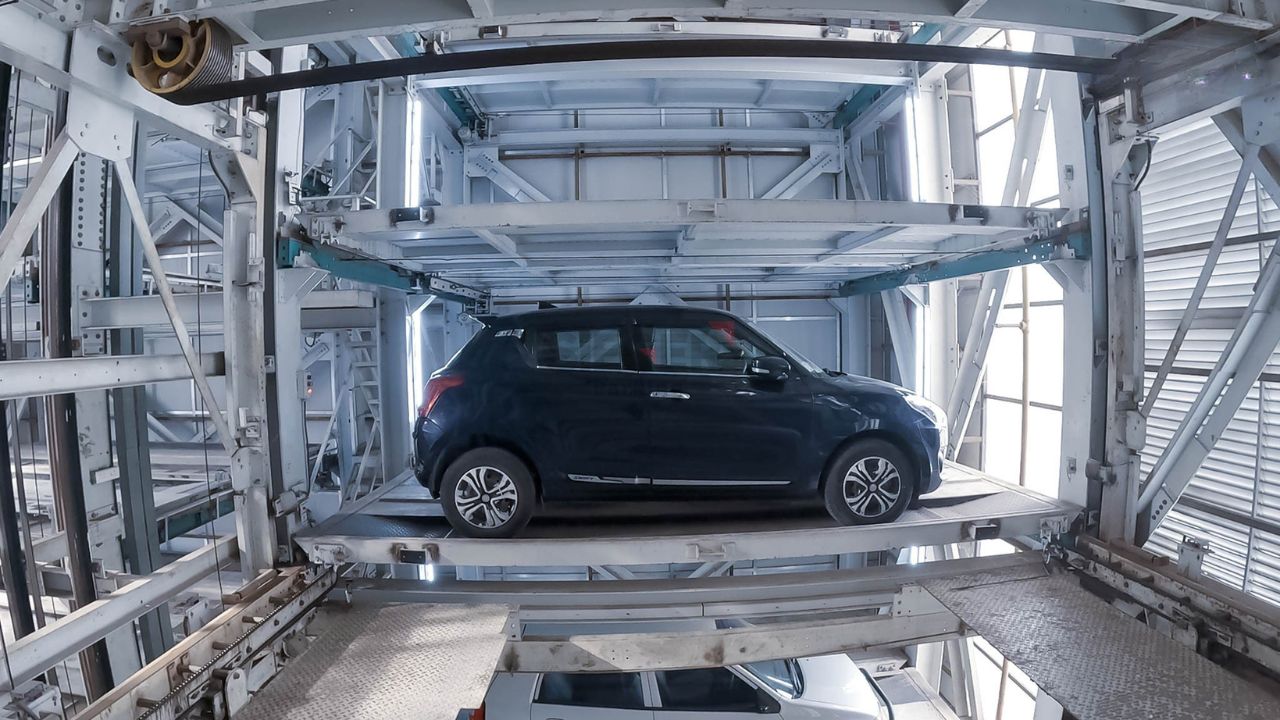 TOWER
TOWERCars stack vertically around a high-speed central lift inside a compact tower. Single-deep and double-deep variants. The highest capacity per square foot of ground taken.
- Motion
- High-speed lift, central shaft
- Benchmark
- Up to 76 cars in 980 sq. ft.
- Suits
- Narrow and linear plots
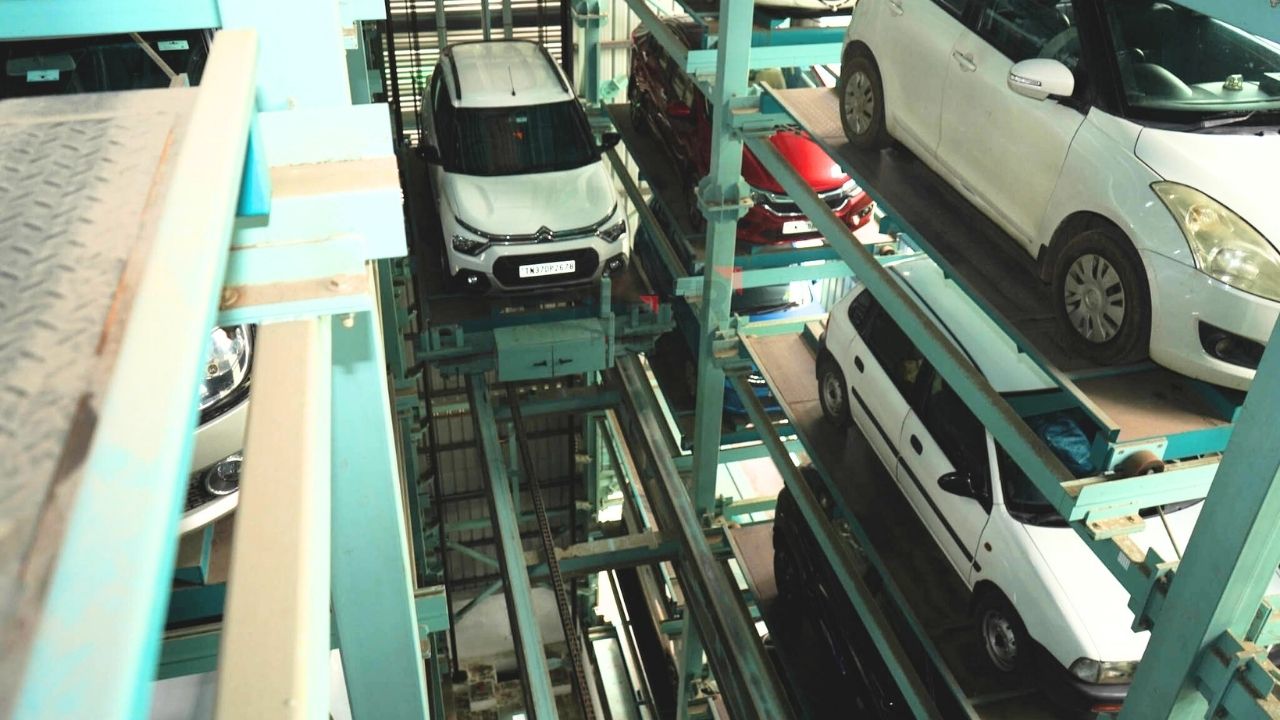 L-CART
A linear cart paired with a wire rope lift turns leftover rectangular strips into dense storage. Lift speeds exceed one metre per second, keeping cycle times short despite the height.
- Motion
- Linear cart + wire rope lift
- Benchmark
- Up to 70 cars from a 6-car plot
- Suits
- Rectangular residual plots
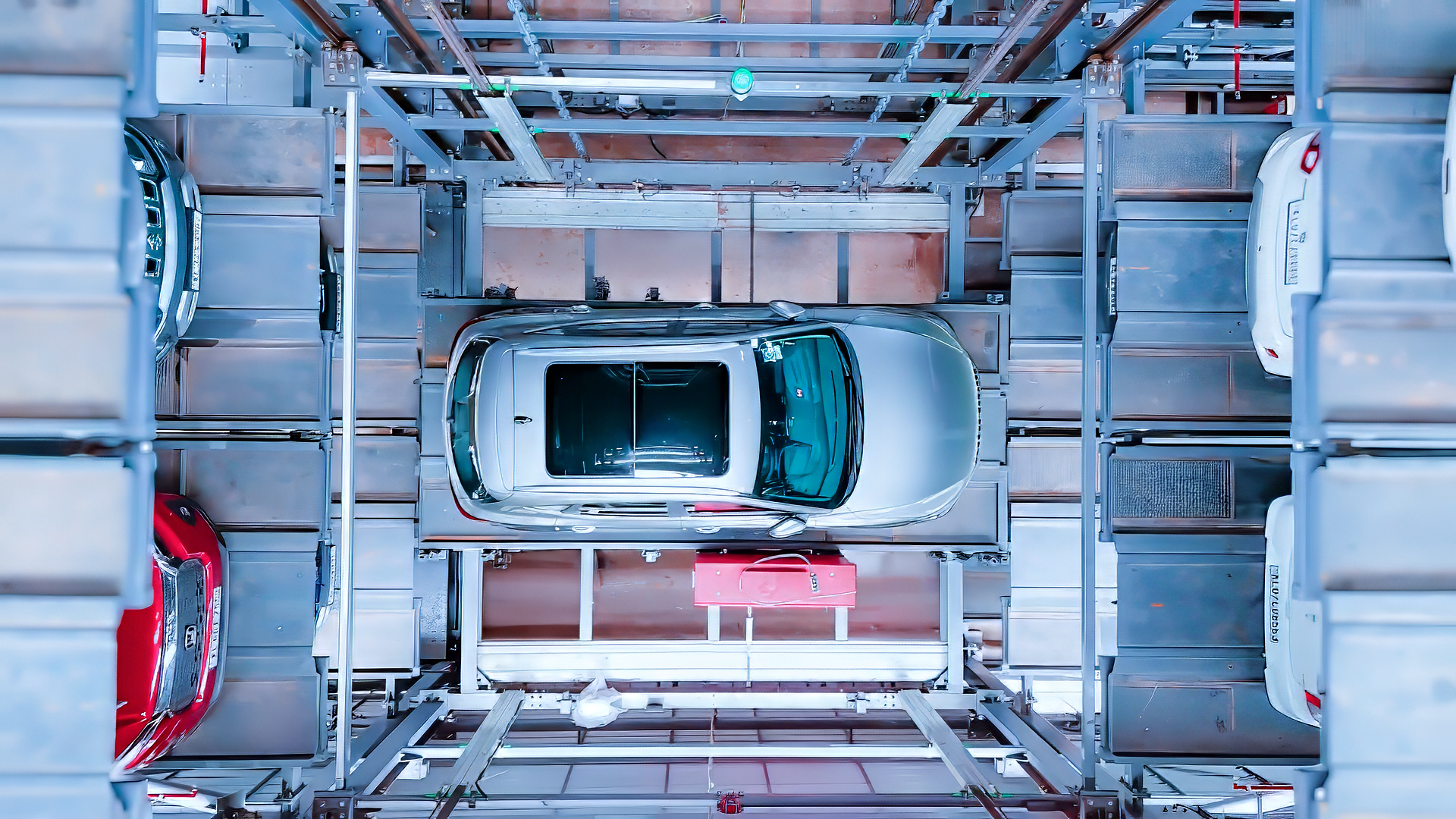 H-CART
H-cart tower
Horizontal carts distribute cars across multiple rows and levels within a tower, allowing up to three parking rows behind one another. Built for large floor plates and high absolute capacity.
- Motion
- Horizontal cart + lift, multi-row
- Benchmark
- 500+ cars, up to 3 rows deep
- Suits
- Hospital and commercial campuses
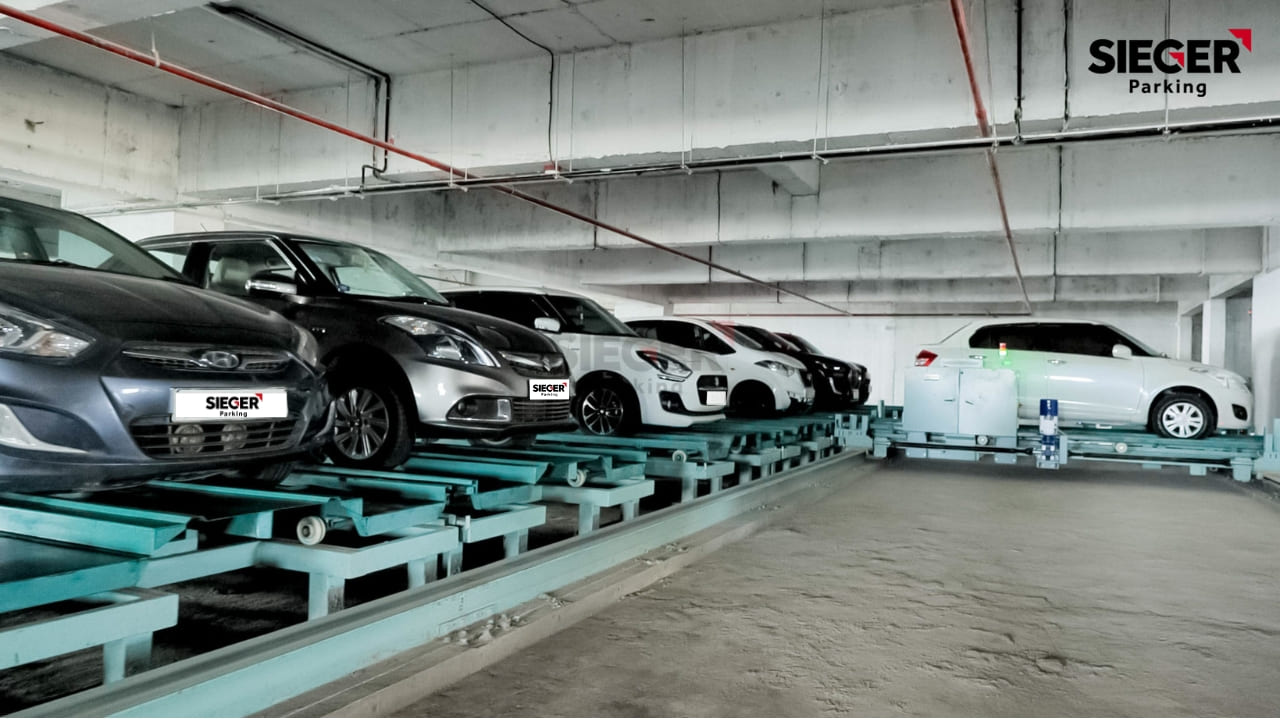 AUTO-CART
High-speed lifts, servo-driven horizontal carts and laser-guided positioning. The fastest category, and the one that scales to public and municipal facilities.
- Motion
- Servo carts + laser guidance
- Cycle
- Typically under 1 minute
- Suits
- Large commercial, institutional, civic
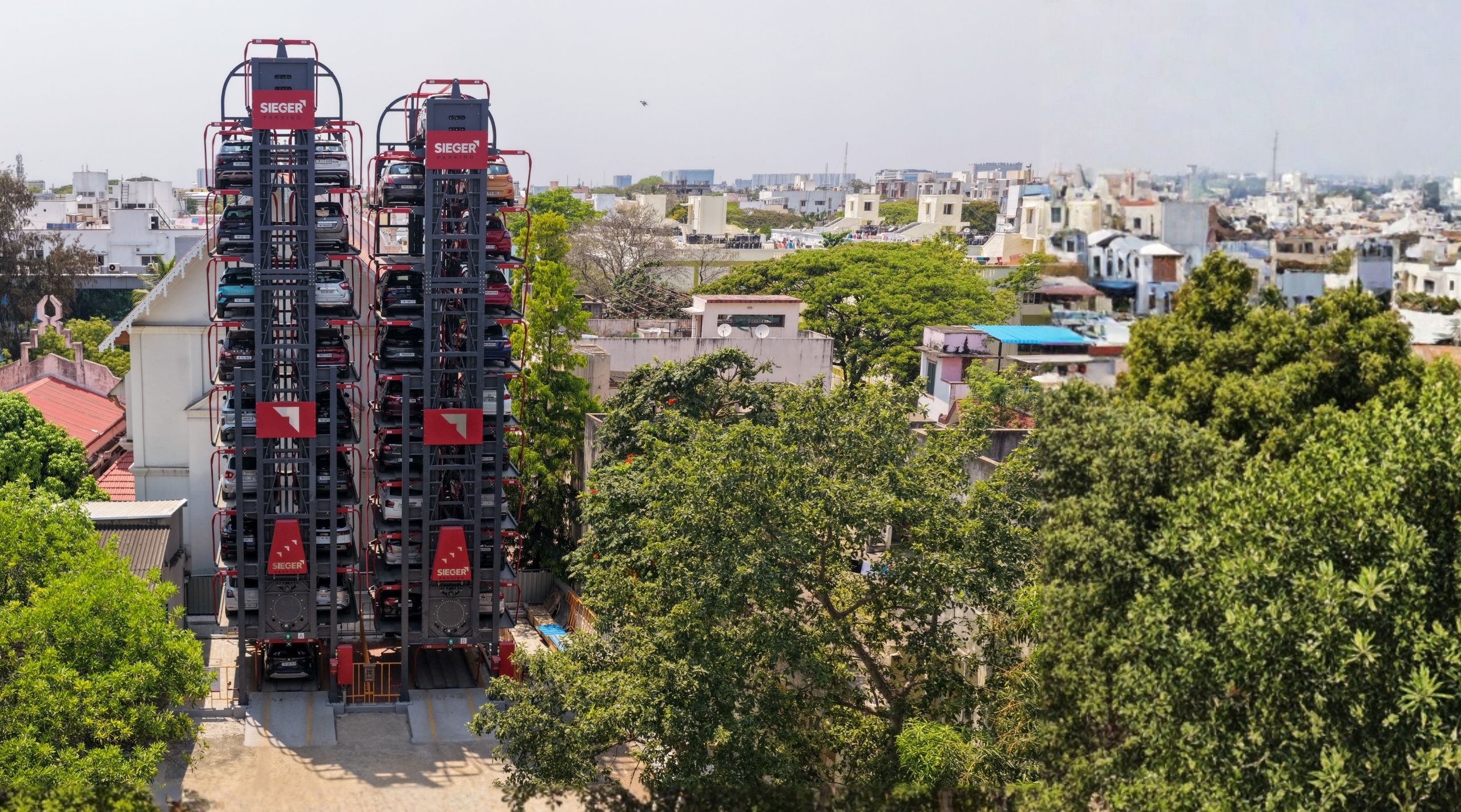 ROTARY
A vertical carousel — platforms rotate in a continuous loop like a Ferris wheel. The smallest viable footprint of any system, which makes it the answer where nothing else fits.
- Motion
- Vertical carousel loop
- Benchmark
- Up to 20 cars in 370 sq. ft.
- Suits
- Extremely tight plots, high-footfall retail
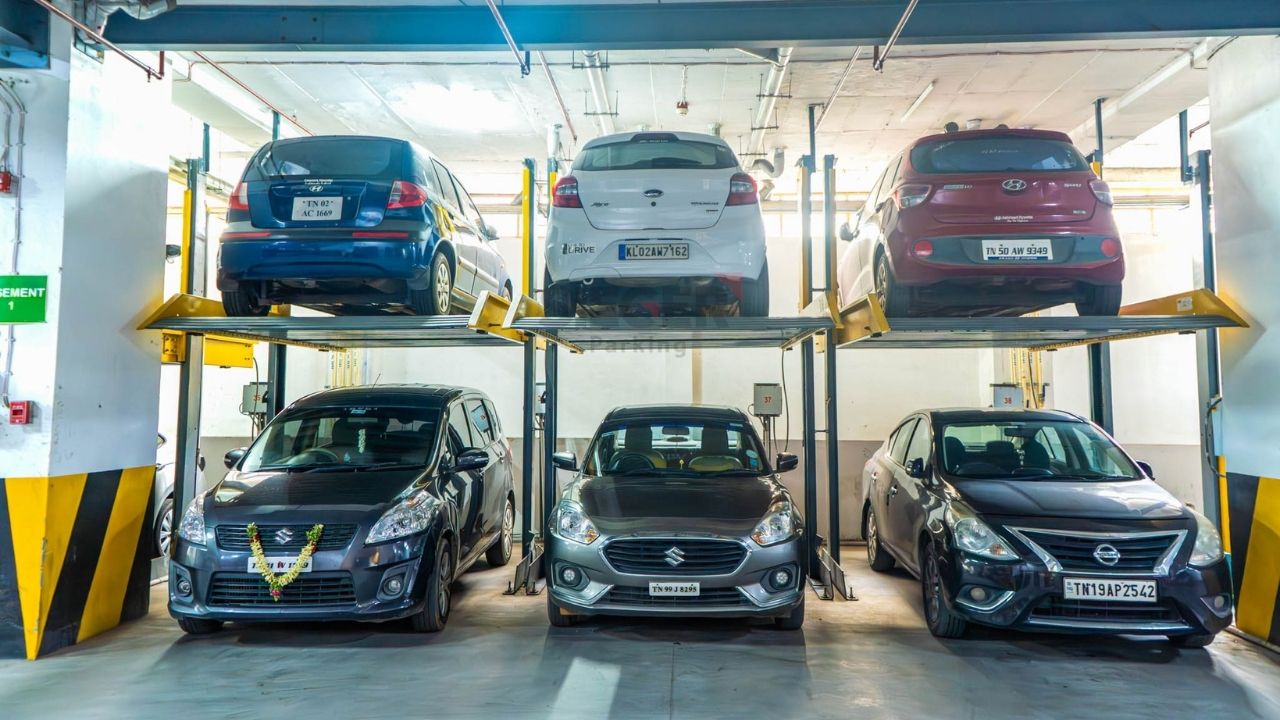 STACK
STACKPlatforms lift cars to create a second or third level directly above the ground space. The most widely installed mechanical system in India, and the simplest to operate and maintain.
- Motion
- Hydraulic platform lift
- Effect
- Doubles or triples existing capacity
- Suits
- Residential, basements, retrofits
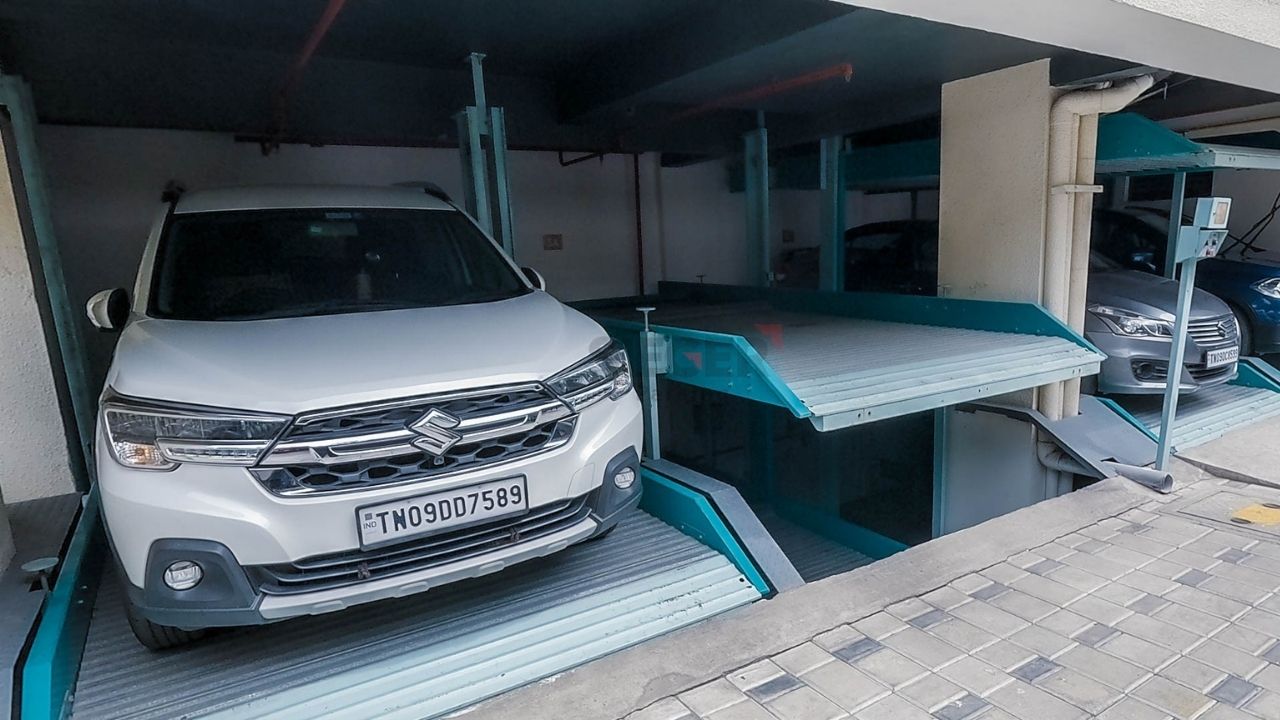 PIT-STACK
Pit-stack parking
A stack system that borrows depth as well as height — one level in a pit below grade plus one or more above. Designed for basements where clear height alone will not support a full stack.
- Motion
- Stack lift with sub-grade pit
- Levels
- 1 below + 1 to 2 above grade
- Suits
- Height-limited basement retrofits
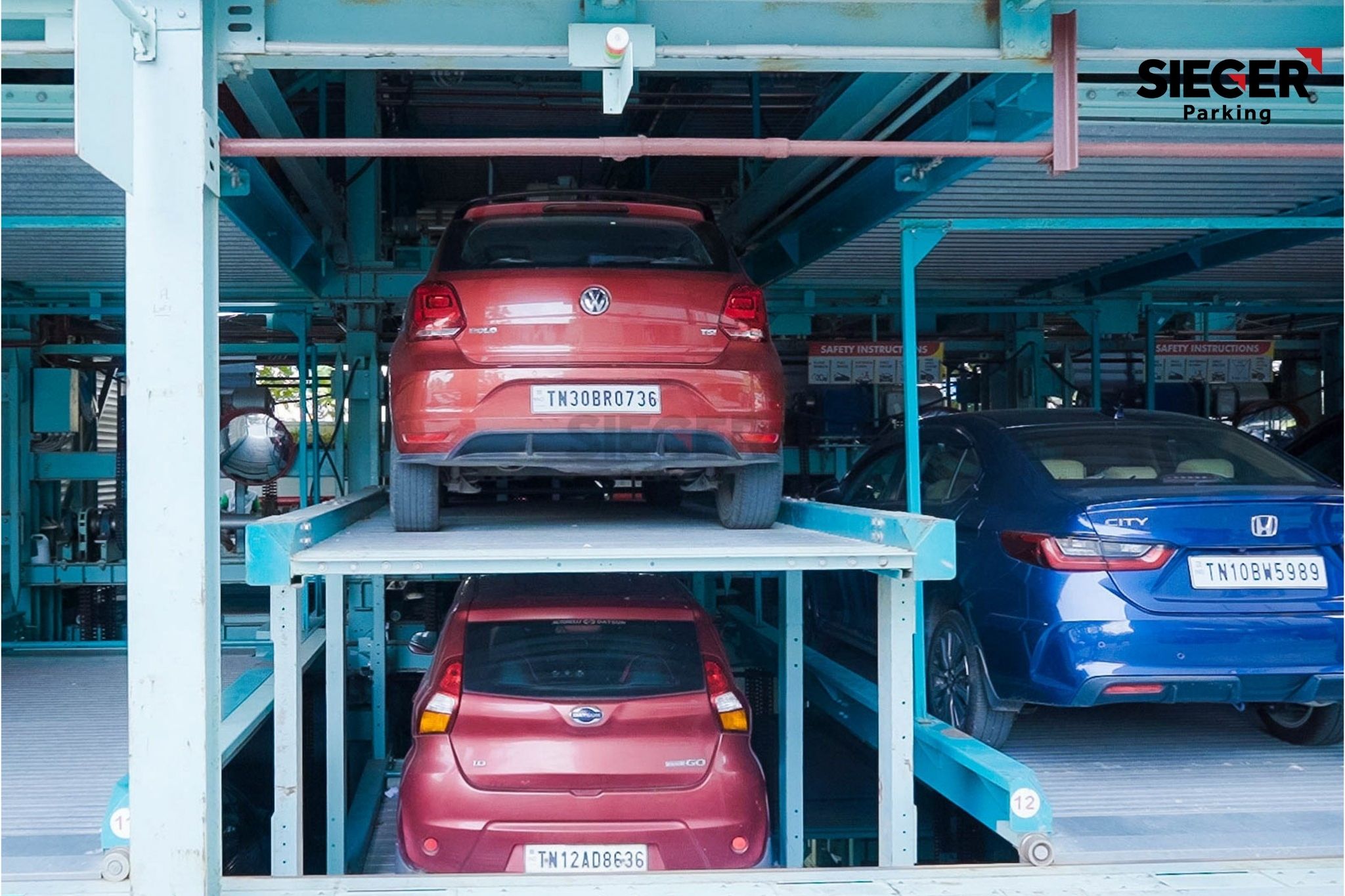 PIT-PUZZLE
The same sliding-platform mechanism as puzzle parking — the difference is a pit. One level sits below grade, so platforms work two levels above and one below, unlocking basement volume that would otherwise be unusable.
- Motion
- Puzzle platforms + sub-grade pit
- Levels
- 2 above + 1 below grade
- Suits
- Existing buildings, basement parking
Fig. 6.2
Match the system to the site
Different land, different system
Plot size, shape and depth decide the answer far more than budget does. Find your site, then the systems built for it.
Very tight plot
Under ~500 sq. ft. of ground
Narrow, linear strip
Long and thin — width is the constraint
Open, wide footprint
Room to spread at grade or podium
Large campus, 500+ cars
High absolute capacity on a big plate
H-CartFully Automated
Basement or retrofit
Depth available, or an existing structure
Pit-StackPit-Puzzle
Section 07
Systems at a glance
A single view of all nine, for shortlisting against a site before detailed design begins.
| System | Mechanism | Built for | Capacity benchmark |
|---|---|---|---|
| Puzzle | Vertical + horizontal sliding platforms | Ground level, podium, open sites | Up to 7 levels, expandable horizontally |
| Tower | High-speed lift in a vertical shaft | Narrow, linear plots | Up to 76 cars in 980 sq. ft. |
| L-cart tower | Linear cart + wire rope lift | Rectangular residual plots | Up to 70 cars from a 6-car footprint |
| H-cart tower | Horizontal cart + lift, multi-row | Large floor plates, campuses | 500+ cars, up to 3 rows deep |
| Fully automated | Servo-driven carts + laser guidance | Large commercial, civic, municipal | Several hundred cars, sub-1-minute cycle |
| Rotary | Vertical carousel | Extremely tight plots, retail frontage | Up to 20 cars in 370 sq. ft. |
| Stack | Hydraulic platform lift, 2–3 levels | Residential, basements, retrofits | Doubles or triples existing capacity |
| Pit-stack | Stack with sub-grade pit level | Height-limited basement retrofits | 1 below + 1–2 above grade |
| Pit-puzzle | Puzzle mechanism with a sub-grade pit | Basement parking, existing buildings | 2 above + 1 below grade |
Benchmarks are peak configurations achieved on delivered projects. Actual capacity is set by plot geometry, clear height, structural grid and the car mix the system must accept.
Reading the benchmarks
Footprint figures — 20 cars in 370 sq. ft., 76 cars in 980 sq. ft. — describe ground area occupied, not floor area built. The capacity comes from the levels stacked above that footprint. This is the number worth comparing when land, not construction, is the binding constraint.
Rotary
20 cars in 370 sq. ft.
Tower
76 cars in 980 sq. ft.
Section 08
Conventional versus mechanical parking
The comparison that decides most projects, across the parameters that reach the budget and the programme.
Cars per 1,000 sq. m. built-up
Conventional
25 – 35
Mechanical
45 – 60+
Park and retrieve time, minutes
Conventional
5 – 10+ at peak
Mechanical
1 – 3
| Parameter | Conventional | Mechanical |
|---|---|---|
| Cars per 1,000 sq. m. built-up | 25 – 35 | 45 – 60+ |
| Ramps and circulation | 30% – 40% of floor area | Not required |
| Driver enters the structure | Yes — drives every level | No — transfer bay only |
| Park and retrieve time | 5 – 10+ min at peak | 1 – 3 min, independent of occupancy |
| Level height | Sized for standing headroom | Sized close to car height |
| Land footprint for equal capacity | Larger | Substantially smaller |
| Lighting and ventilation | Continuous, across all levels | Minimal — no human occupancy in storage |
| Security of parked cars | Depends on CCTV and personnel | No public access to the storage area |
| Internal traffic | Congestion routine at peak | Eliminated — no circulation inside |
| Operating manpower | Higher — security, traffic, housekeeping | Lower — system-operated |
| EV charging | Per-bay wiring across every level | Centralised at transfer level |
| Best suited to | Large plots with land to spare | Space-constrained urban sites |
Density is stated per 1,000 sq. m. of built-up area. At 25 to 30 sq. m. per conventional space including its share of the aisle, 1,000 sq. m. yields roughly 33 spaces — consistent with the range above.
Fig. 8.2 Same built-up volume · why the yield differs
Conventional
~333
cars · 4 tall levels, 30–40% lost to ramps
Mechanical
~555
cars · 7 compressed levels, fully packed
Both multi level parking structures occupy 10,000 sq. m. of built-up area. The mechanical system fits three more levels into the same height because its decks are sized to car height rather than standing headroom, and it packs each deck completely because no floor area is surrendered to ramps or aisles.
Fig. 8.3 Worked example · 10,000 sq. m. of built-up parking area
Conventional 10,000 ÷ 30 sq. m./car = ~333 cars
Mechanical 10,000 ÷ 18 sq. m./car = ~555 cars
Difference +222 cars · +67% on identical built-up area
The gap comes from two places, not one: removing circulation recovers 30–40% of the plan, and reducing level height from occupied-space height to car height adds more storage per metre of building. On a volume basis rather than a floor-area basis, the multiple typically lands between 2× and 3×.
Stated plainly: conventional parking spends 30% to 40% of its built-up area moving drivers around. Mechanical parking spends that same area storing cars. Same footprint, same construction budget — materially different yield.
Section 09
How each one actually works
The two families differ most in what they ask of the user. One asks the driver to do the work of finding and reaching a space; the other ends the driver's involvement at the door.
Fig. 9.1Parking and retrieving, step by step
Conventional
The driver does the work
- 01Enter through the boom barrier or access gate.
- 02Navigate ramps and circulation roads between levels.
- 03Search each level for an available space.
- 04Park, and note the level and bay.
- 05Walk to stairs, lifts or escalators.
- 06On return, relocate the car and drive out through internal roads.
6 steps · 5–10 min at peak · driver inside the whole time
Mechanical
The system does the work
- 01Drive onto the platform in the ground-level transfer bay.
- 02Get out and step clear into the safe zone.
- 03Sensors verify position and dimensions; the system stores the car.
- 04To retrieve, identify the car at a panel, card reader or app.
- 05The car is returned to the transfer bay in 1 to 3 minutes.
5 steps · 1–3 min at any occupancy · driver never enters
Standard space dimensions
Conventional bays are typically 2.5 m × 5.0 m for sedans and hatchbacks and 2.7 m × 5.5 m for SUVs. Including its share of the aisle, each space consumes roughly 25 to 30 sq. m. of floor area. In mechanical systems the governing dimension is the platform, not the aisle — which is why area per car falls so sharply.
Sizing for peak, not for capacity
The most common sizing error in mechanical and automated parking is designing for total spaces and forgetting throughput. Capacity determines how many cars fit; the number of transfer bays determines how fast the facility clears at 9am and 6pm.
Fig. 9.3 Throughput · rule of thumb
cars/hour = (60 ÷ cycle time in minutes) × transfer bays
example = (60 ÷ 1.5) × 2 = ~80 cars/hour
A 400-car system with a single transfer bay on a 90-second cycle clears about 40 cars an hour — over an hour and a half to empty a quarter of the building. The same system with three bays clears it in half that. Peak demand should set the bay count, and the cycle time used must be the project's own, verified against travel distance and level count.
What to ask a supplier
Request the cycle time at the furthest slot, not the average, and the modelled peak-hour throughput for the proposed bay count. Averages hide the worst case, and the worst case is what users experience on a Monday morning.
Section 10
Where conventional parking runs out of road
Conventional parking works, and will keep being built. Its limits become material as projects scale and as land prices rise.
Capacity lost to everything that is not a car
A conventional parking structure is large on paper and smaller in practice. Floor area goes to ramps between levels, internal driveways, turning radii, staircases and emergency exits, lift lobbies, ventilation and plant rooms, electrical and utility spaces.
Across industry benchmarks and delivered projects, those elements consume 30% to 40% of total floor area. Hitting a capacity target therefore means building bigger or digging deeper — both of which raise cost and programme risk.
- Ramps between levels
- Internal driveways
- Turning radii
- Staircases and emergency exits
- Lift lobbies
- Ventilation and plant rooms
- Electrical and utility spaces
A footprint that grows faster than the capacity
To match a mechanical system's capacity, a conventional structure needs materially more area. As demand rises, the project faces two options — build wider above grade or add basement levels below. Both are expensive, and in a constrained plot both eat into leasable area, green space or future expansion.
Congestion that the building creates itself
Because finding a space is the driver's job, high occupancy produces bottlenecks at ramps and junctions, queues at entry and exit, and rising travel time inside the facility. In busy conventional facilities, up to 30% of peak-hour internal traffic is cars already inside, still circling. That degrades the user experience, accelerates wear on ramps and signage, and burns fuel for no distance travelled.
Up to 30%
of peak-hour internal traffic is cars already inside, still circling
Highlighted: up to 3 in every 10 cars
Operating cost that outlives the construction budget
Capital cost dominates planning conversations; operating cost dominates ownership. A conventional facility runs continuous lighting, mechanical ventilation, parking guidance, CCTV, passenger lifts, access control and electrical distribution for its whole life — plus manpower for security, traffic management, housekeeping and maintenance.
Lifecycle perspective
Lifecycle analyses indicate that 20-year operating cost for a large conventional parking facility can equal or exceed its original construction cost. Energy alone — lighting, ventilation, lifts — commonly accounts for 40% to 50% of annual operating expenditure.
Environmental cost
Oversized parking structures carry an environmental price too. Additional concrete and steel raise embodied carbon, and large impervious surfaces intensify the urban heat island effect.
Section 11
What mechanical parking changes
Each limitation above traces back to the same root cause — a driver inside the building. Removing the driver removes the cause, not just the symptom.
Circulation space disappears
With the machinery moving cars, ramps, driving lanes and turning areas are simply not built. The whole parking structure becomes storage, lifting density by two to three times against a conventional building of the same size.
Smaller footprint at equal or higher capacity
A rotary system holds 20 cars in 370 sq. ft. A tower system holds up to 76 in 980 sq. ft. The land that would have gone to parking stays available for the parts of the project that generate returns.
No internal traffic to manage
Users interact only with the transfer bay. There is no circulation inside, no peak-hour bottleneck at a ramp, and no time spent hunting for a space — which also removes the idling that goes with it.
Lower running cost
With no human occupancy in the storage area, continuous lighting, ventilation and extensive patrolling are not required. Equipment draws power only during park and retrieve cycles, and staffing requirements fall accordingly.
Safety designed out rather than managed
Cars sit inside a closed system that no unauthorised person enters, which removes the exposure that produces theft, vandalism and door damage. Car detection sensors, anti-fall locks, emergency stops and PLC interlocks handle the machinery side.
The through-line is consistent: mechanical parking addresses every structural limitation of conventional parking — wasted circulation, oversized footprint, internal congestion, running cost and exposure of parked cars — because it changes who moves the car.
Section 12
Cost and lifecycle economics
MLCP cost is not a single number, and any figure quoted without site conditions attached should be treated as indicative only. These are the variables that actually move it.
System type
Conventional ramped structure versus mechanical. Mechanical carries higher equipment cost up front and delivers more cars per square foot with lower running cost across the life.
Number of levels
More levels raise structural and equipment cost, and multiply capacity on the same footprint. The trade sits between them.
Total car spaces
A 50-car requirement and a 500-car requirement have fundamentally different cost curves; per-space cost usually falls with scale.
Site conditions
Soil type, water table, access for erection and any existing structures drive the civil scope — often the largest swing factor on a basement project.
Degree of automation
Semi-automated stack and puzzle systems cost less than fully automated systems with servo drives, laser guidance and horizontal carts.
Civil and structural scope
Above grade, below grade, or integrated into an existing building — each has a different structural engineering and construction cost.
Ventilation and building services
Conventional structures need full mechanical ventilation across every level; mechanical systems with no human occupancy in storage typically need considerably less.
Power and standby
Connected load, standby generation and the retrieval strategy during an outage. Decide this at design stage, not at handover.
Maintenance and AMC
Annual maintenance, spares availability and response times over a 15 to 20 year life belong in the comparison from the start.
Fig. 12.1
Capital is only half the story
Two costs over a 15–20 year life
Mechanical usually costs more to build and far less to run. Compared on total cost per car space over the life, the shorter bar wins.
Conventional
Mechanical
Capital / build cost
Operating cost over 20 years
Illustrative proportions, not a quotation — bar lengths show relative total cost per car space over the life. The point holds regardless of the exact split: a higher build cost can still deliver the lower whole-life cost.
The comparison that matters
Compare options on cost per car space over the design life, not headline capital cost. A system that costs more up front but delivers twice the density on the same footprint — and runs on a fraction of the energy and manpower — routinely wins on cost per space against a cheaper multi storey car park that needs more land and more area to hold the same cars.
Section 13
Planning checklist
These are the inputs a parking system needs from the design team. Settling them early is cheap; settling them after the structure is designed is not.
- Car mix
The proportion of SUVs and larger cars the system must accept, and the resulting platform sizes and weight limits.
- Clear height
Available floor-to-soffit height, level by level, including services running below the slab.
- Pit depth
For pit-stack and pit-puzzle systems, excavation depth against water table and adjacent foundations.
- Structural loads
Point loads and dynamic loads from the system, issued to the structural engineer before design is frozen.
- Transfer bay count
Driven by peak-hour throughput, not by total capacity. See the sizing note in Section 09.
- Queuing and approach
Stacking space in front of the transfer bays so a peak queue never backs onto the public road.
- Power and standby
Connected load, standby generation, and how cars are retrieved during a power failure.
- EV charging strategy
How many charged bays, at which level, and whether charging happens at the transfer level or in storage.
- Drainage
Run-off from wet cars, wash-down water and monsoon ingress, especially in pit configurations.
- Maintenance access
Physical access for servicing, spares delivery routes, and the annual maintenance contract scope.
- Phasing
Whether capacity is installed at once or scaled in modules as occupancy builds.
Fig. 13.1 Save & share
Checklist for choosing a multi level car parking system
- How many cars, and what is the peak-hour demand?
- What are the plot dimensions and shape?
- What is the clear height, level by level?
- Basement depth available, or above grade only?
- What car mix must it accept (SUV share)?
- How many transfer bays does peak demand need?
- EV charging — how many bays, and where?
- Standby power and retrieval during an outage?
- Cost per car space over 15–20 years, not just capital?
- Phased build, or full capacity on day one?
Section 14
Safety and standards
Mechanical parking is powered machinery that the public stands next to, so safety is engineered into the operating logic rather than bolted on afterwards.
Layers built into the system
- Car detection and dimension sensing — confirms the car is correctly positioned and within length, width, height and weight limits before any movement begins.
- Presence interlocks — PLC logic that will not permit platform movement while a person or car is detected in the operating zone.
- Anti-fall locking devices — mechanical locks that hold a platform if a lifting element fails.
- Emergency stop controls — accessible at the transfer bay and at maintenance positions.
- Physical separation — the storage area is enclosed, and the public does not enter it during operation.
Frameworks that apply
- National Building Code of India (NBC) 2016 — parking provisions and means of egress for buildings.
- Local development control regulations — parking ratios, setbacks and height limits, set by the municipal corporation or urban local body and revised periodically.
- EN 14010 — the European standard covering safety of power-driven equipment for parking motor vehicles, widely referenced in equipment specification.
Verify locally
Parking norms vary by city and are revised periodically. Treat the frameworks above as a starting point and confirm current requirements with your local authority for the specific site before design is frozen.
Section 15
What comes next
Four shifts are visibly changing what gets specified.
EV charging as a default requirement
As electric car share rises, charging stops being an add-on. Mechanical systems hold an advantage here: charging can be centralised at the transfer level instead of wired to every bay on every floor.
Connected monitoring
IoT sensors, cloud monitoring and app integration are becoming standard — real-time occupancy, remote retrieval requests, and predictive maintenance alerts raised before a fault becomes downtime.
Sustainability in the specification
Rooftop solar, rainwater harvesting and efficient lighting are increasingly written into parking briefs. Compact footprint and low energy draw align mechanical systems naturally with green building certification.
Modular, phased capacity
Newer systems are designed to scale in modules, letting a development add capacity as occupancy builds rather than funding peak capacity on day one.
Section 16
Frequently Asked Questions
What is multi level car parking?
Multi Level Car Parking (MLCP) is parking infrastructure that stores cars on two or more vertical levels within a single footprint, using either conventional ramp-based structures or mechanical systems such as puzzle, tower, rotary and stack parking. Rather than spreading parking horizontally across land, MLCP uses vertical space to park more cars in less ground area.
What is the full form of MLCP?
MLCP stands for Multi Level Car Parking. It describes any parking structure or system that parks cars across two or more vertical levels — conventional ramp-driven designs and automated mechanical systems alike.
What is the difference between conventional and mechanical parking?
In conventional parking the driver personally drives through the facility, using ramps and circulation lanes to reach a space. In mechanical parking the driver leaves the car at a ground-level transfer bay and the system lifts and moves it to a slot. Mechanical parking stores two to three times more cars in the same building volume, because it removes ramps, driving lanes and turning areas, and because level heights can be reduced to roughly car height rather than occupied-space height.
How many cars can a multi level car parking system hold?
Capacity depends on system type, footprint and level count. A rotary system parks up to 20 cars in about 370 sq. ft. of ground area. A tower system parks up to 76 cars in about 980 sq. ft. Puzzle and fully automated systems scale to several hundred. Measured by floor area, conventional structures deliver roughly 25 to 35 cars per 1,000 sq. m. of built-up area, and mechanical systems roughly 45 to 60.
What types of mechanical parking systems are available?
Nine common types, ranging from semi-automated to fully automated parking: puzzle (platforms move vertically and horizontally like a sliding puzzle); tower (cars stacked around a central lift); L-cart tower (linear cart and wire rope lift for rectangular plots); H-cart tower (horizontal carts for multi-row, high-capacity layouts); fully automated (servo carts with laser guidance); rotary (vertical carousel); stack (platforms lift cars to create extra levels); pit-stack (stack variant using a sub-grade pit); and pit-puzzle (puzzle variant for basements).
What drives the cost of a multi level car parking system?
System type, number of levels, total car spaces, site conditions such as soil and water table, degree of automation, civil and structural scope, ventilation and building services, electrical and standby power, and long-term maintenance. Comparing options on cost per car space across a 15 to 20 year life gives a truer picture than comparing headline capital cost.
How fast is a mechanical parking system?
A single park or retrieve cycle typically runs one to three minutes depending on system type and travel distance. Facility throughput matters more than a single cycle: cars per hour is roughly 60 divided by cycle time in minutes, multiplied by the number of transfer bays. Two bays on a 90-second cycle handle about 80 cars an hour. Peak demand, not total capacity, should set the bay count.
Where is multi level car parking commonly used?
Residential complexes, commercial offices, hospitals and healthcare campuses, airports, railway and metro stations, shopping malls, IT parks, hotels, educational institutions, government buildings, mixed-use developments and industrial facilities.
Is mechanical parking safe?
Modern mechanical parking systems are engineered with layered safety: car detection and over-dimension sensors, anti-fall locking devices, emergency stop controls, and PLC interlocks that prevent platform movement while a person or car is detected in the operating zone. Because drivers do not enter the storage area during operation, exposure to moving equipment is designed out rather than managed — and theft and vandalism risk falls with it.
Bring the site, not just the car count
Plot dimensions, clear height, water table and peak-hour demand determine which of the nine systems will actually work. Send those and the shortlist gets short quickly.
About the author
Sieger Parking, established in 1994, designs, engineers, manufactures and installs multi level car parking systems from a 3,00,000+ sq. ft. facility. With 15,000+ car spaces installed across India and international markets, Sieger has delivered parking for multi-speciality hospitals, one of India's largest retail chains, leading real estate developers, Government of India Smart City projects and educational institutions. The product range centres on puzzle parking, tower parking, L-cart tower parking, H-cart tower parking, rotary parking and fully automated (auto-cart) parking systems.